



METHODOLOGICAL APPROACH
ECos are distinctive in that in addition to sharing “common” resources, such as renewable energy plants, batteries, hydrogen production, storage and re-electrification facilities, EV charging areas, and thermal units, any individual resources, such as PV panels, batteries, CHP units, etc may be used cooperatively within the community for mutual benefit. Thus, the sizing of ECo components—whether shared or individual (owned by participants)—is very important both in the ECo design phase, and during its growth.
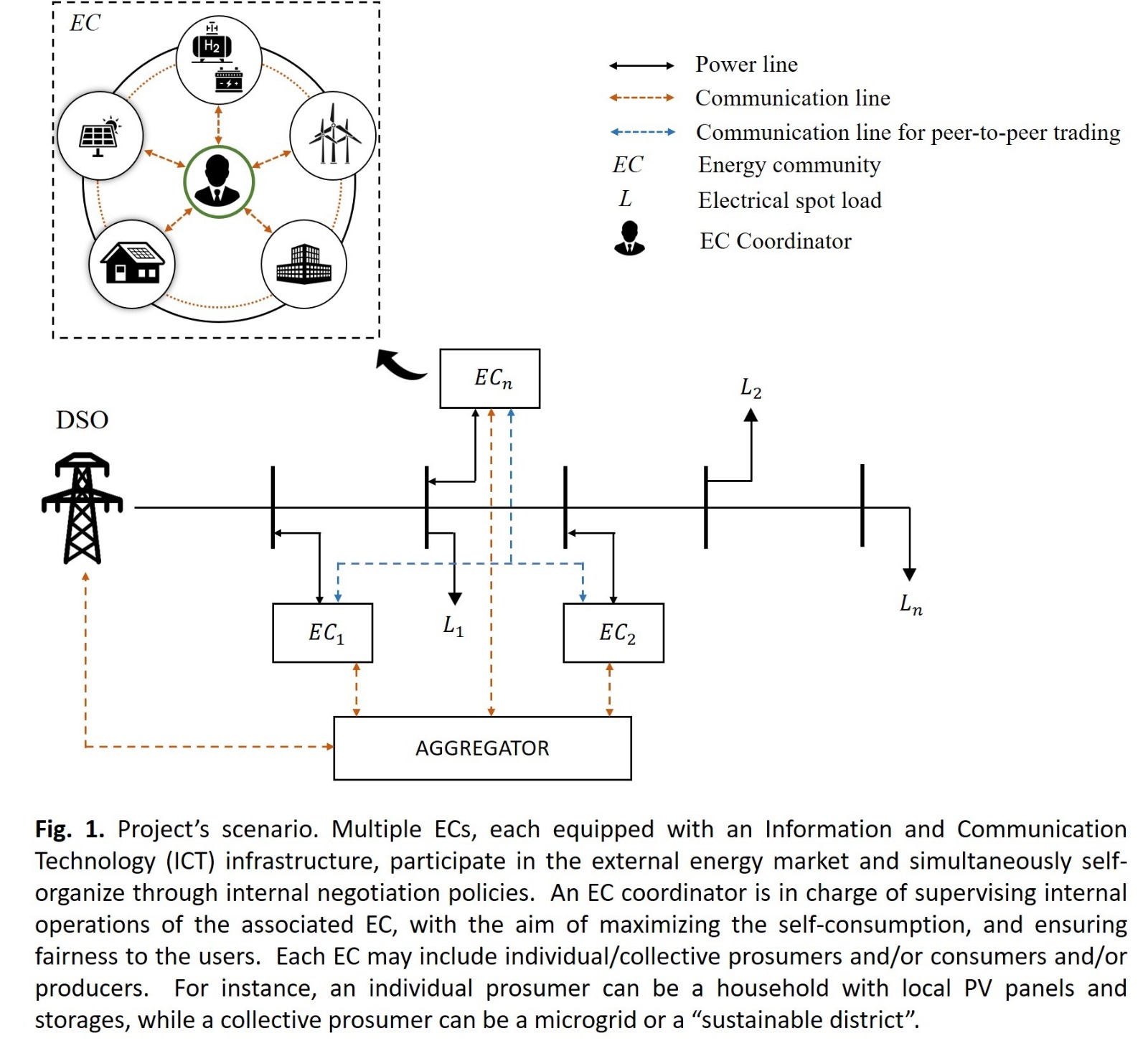
Addressing the scenario depicted below in Fig. 1, the project seeks to propose and test solutions for sizing ECos in their design phase, and for managing internal and external operations during the operational phase.
All problems are set as optimization programs, where the agents may be interested in optimizing various possible objectives, including but not limited to:
- return on investment;
- green energy usage;
- energy self-consumption;
- demand matching;
- demand response, valley filing and peak shaving; or
- measures of “fairness” towards ECo members.
Further, due to the dynamic nature of the storage system(s) or demand-response policies, the optimization problems span an appropriate time interval.
ECos are distinctive in that in addition to sharing “common” resources, such as renewable energy plants, batteries, hydrogen production, storage and re-electrification facilities, EV charging areas, and thermal units, any individual resources, such as PV panels, batteries, CHP units, etc may be used cooperatively within the community for mutual benefit. Thus, the sizing of ECo components—whether shared or individual (owned by participants)—is very important both in the ECo design phase, and during its growth. Therefore, the corresponding optimization problem will have a time horizon of several years covering the life of the components, and will typically be fixed, not “moving”.
While necessarily taking into account the technological market of the components in terms of available sizes and corresponding costs, the sizing will particularly address:
-the optimal number of members in an ECo, for a given finite quantity of shared resource(s), so as to maximize self-consumption and energy shared within the ECo;
-the optimal sizing of individual resource(s), for a given finite number of ECo members, so as to maximize self-consumption and energy shared within the ECo;
-the optimal sizing of individual/shared resource(s) and number of ECo members, subject to investment constraints, so as to maximize self-consumption and energy shared within ECo, as well as additional revenue earned through participation in ancillary grid service(s).
In dealing with internal and external operations, at each decision instant, for example every hour or 30 minutes, an agent takes control decisions associated with controllable subcomponents of the energy system (energy storage, electric vehicles, (co)generation units or flexible load), also on the basis of input signals (eg price signals or “flexibility” requests) received from peers or some entity farther up in the hierarchy [5]. In such a case a “moving”, receding-horizon approach will be employed, in that the optimization, rooted at the current time, covers a certain future horizon - say 24 hours – over which a sequence of optimal decisions is determined. Of those decisions only the first one, at the current time, is taken and used by the agent; the horizon is then shifted forward at the next decision instant (it recedes, from another viewpoint) when the next optimization problem will be solved, after receiving “fresh” data from the field. Such a horizon-ahead phase is error-prone due to the fact that actions in the future are bound to depend on forecasts, typically of demand and RES production [1]. In some cases a corrective phase will be designed, where actions on a shorter time-scale are taken to counter the imbalances occurring due to the uncertainties of the horizon-ahead phase [1]. Alternative approaches take the uncertainty into account at the horizon-ahead phase itself, in a deterministic setting or in a probabilistic setting [3]. All the above methods are often and comprehensively covered under the term “model predictive control” which typically exploits the available physical model of the system at hand, to predict the evolution of its behavior in the (receding) future and accordingly decides the optimal sequence of control inputs. In the case at hand, the model of the system would comprise the allowed energy exchange among various (sub)components, the characteristics of the (sub)components, the cost associated with each (sub)component and so on.
Such "model-based" techniques would be enriched with application of complimentary data driven methods—such as machine learning, deep learning and reinforcement learning—particularly when obtaining a physical model of the system is difficult or the computational burden is a very stringent requirement. An alternative research direction also hypothesizes the use of data-driven black-box estimates as a "good initial guess" that helps speed up obtaining the solution(s) for the large-scale optimization problem(s).
Given that in ECo internal operations, decision making is facilitated by the ECo coordinator, in particular, the following will be modelled:
- peer-to-peer energy sharing of individual/shared resources (such as PV plants and storage systems) to maximize the additional revenue obtained due to increased self-consumption of the energy generated within the EC;
-metrics to ensure fairness in the distribution of profits among ECo members under different use-case scenarios, such as individual/shared resources.
Considering that ECos may also achieve their objectives through external action involving an aggregator, the methodological approach comprises two optimization problems being cast:
- peer-to-peer trading of inward/outward power flows allowing ECo participants to reduce the energy purchased from the grid at (possibly high) current prices (spot market);
-maximization of the aggregator and ECo revenues by using the inward/outward power flows of the aggregated ECos while participating in the balancing market with ancillary services.
Distributed algorithms for internal/external operations, wherein the agents exchange computation, will be designed with a twofold goal:
-intrinsic scalability of the designed distributed protocols will allow users of ECos to exploit local computing resources available at each node, thus reducing computation costs even in large-scale scenarios;
-the structure of the distributed computing paradigm, wherein users are active participants through local exchange rules, will increase the transparency and explainability of the negotiation strategies, thereby enhancing user trust while also favoring the ECo aggregation and duration.
PROJECT OVERVIEW
TARGETS: GOALS & OBJECTIVES
WORKPLAN
WORK PACKAGES
MILESTONES & DELIVERABLES