



ECODREAM Final Project Report
|
ECODREAM was developed to deliver innovative “ECo" solutions designed to harness the potential of Energy Communities (ECos), which are key to developing sustainable urban environments supported by flexible and stable smart energy grids. ECos are formed by proximate end-users, including public and private entities, having respective electrical and/or thermal energy demands, who enter mutually agreed, resource-sharing contracts, to pool and optimise use of their respective (individually/jointly-owned) distributed renewable energy generation and storage assets. In so doing, ECos effectively deliver potential environmental, social, and economic benefits - i.e. “triple bottom-line” benefits. This report summarizes the implementation and results of the ECODREAM project, detailing the technical contributions, methodological advancements, and strategic outcomes achieved by the project partners: UNINA, UNIGE, and UNIBO. |
|
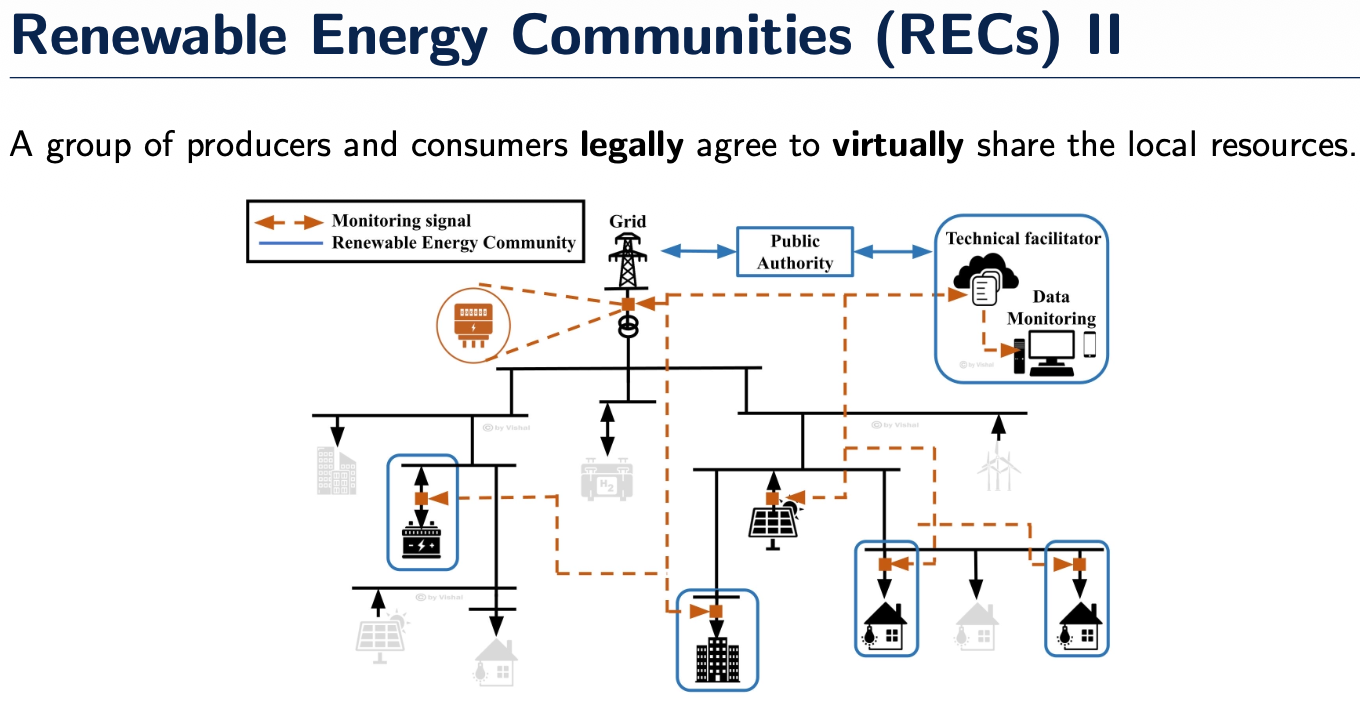
▪ Environmental: greater RES production and self-consumption, leading to lower overall carbon footprint ▪ Social: increased end-user/community engagement and participation ▪ Economic: lower distribution/transmission costs and grid losses; energy cost savings and revenue potential for ECos |
❖ ECo Design ▪ Optimal component sizing and community sizing ❖ ECo Operations & Management ▪ Internal (intra-community) operations assuming cooperative behaviours ▪ External (inter-community) operations involving multiple ECos under a common aggregator assuming cooperative or competitive behaviours ▪ Generating localised control policies ensuring global optimality, safety ❖ Validation & Scalability Testing ▪ Testing on emulated, scaled-down ECo integrating the Smart Polygeneration Microgrid (SPM) and Smart Energy Building (SEB) at UNIGE (University of Genova) Savona Campus ▪ Realistic large-scale simulations based on real data from Roseto Valfortore ECo |
1. Project Plan Implementation
1.1 UNINA
During the implementation phase, the UNINA team focused primarily on the development of advanced modelling and optimisation tools to support both the internal and external operations of Energy Communities (ECs), within the framework of WP2. The research activities concentrated in particular on optimal sizing problems for ECs, considering alternative business models characterised by different configurations of investment responsibility (“the investor”) and incentive distribution mechanisms among community members.
A central methodological challenge concerned the installation decision-making process, namely determining the optimal number of photovoltaic (PV) panels and battery energy storage systems (BESS). This problem was formulated as a long-term optimisation program, with a planning horizon extending over several decades. Such a horizon leads to a very large number of constraints—especially those related to load balancing—rendering standard optimisation solvers computationally inefficient or impractical.
To address this challenge, the research was structured into three main modules, each corresponding to a specific modelling scenario and solution approach.
Module 1 – Periodicity-Based Optimal Sizing for Household PV-BESS Systems
This module addressed the simplest configuration, namely a single household investing in rooftop PV panels and/or battery storage, with the possibility of self-consumption and surplus energy export to the grid.
Given the long planning horizon, the approach exploited the intrinsic periodicity of both solar generation and electricity demand. Using historical data, a norm minimisation problem was formulated to extract representative periodic signals for each season (spring, summer, autumn, winter), each defined as a weekly profile.
These periodic signals were then used within the optimisation framework, significantly reducing the number of constraints while preserving the key dynamics of the system. The approach demonstrated strong performance when validated against real data, particularly when:
-
L1 norm minimisation was used for solar generation profiles
-
L2 norm minimisation was used for demand profiles
The resulting solutions provided accurate estimates of optimal system sizing, with payback periods ranging between 8 and 12 years, depending on inflation assumptions.
Module 2 – Techno-Economic Modelling for Renewable Energy Communities
Building on Module 1, this module extended the periodicity-based approach to the context of Renewable Energy Communities (RECs), incorporating a more complex organisational and financial structure.
The model considered a technical facilitator (TF) operating under the following assumptions:
-
Annual rooftop lease agreements (RLA) with third-party property owners
-
Financing of installations through bank loans, repaid over a defined horizon
-
Physical coupling of PV systems and batteries to enable storage of surplus energy
-
Compensation through public incentives, partially redistributed among community members
A key feature of the model was the incentive distribution mechanism, based on each member’s marginal contribution, approximated through their share of aggregate demand.
The framework was applied to a real-world case study: the municipality of Roseto Valfortore (Apulia, Italy), comprising 43 consumers. Simulation results highlighted important trade-offs:
-
Higher TF incentive retention leads to increased installations and shorter payback (~10 years)
-
Higher redistribution to members reduces investment incentives, potentially resulting in no battery deploymentwhen redistribution exceeds 60%
Module 3 – Multi-Stage Investment under Participation Uncertainty
This module introduced a more realistic and dynamic setting, modelling an EC as a cooperative system with uncertain participation.
Two key assumptions were introduced:
-
Participant behaviour is stochastic, allowing for entry, exit, and re-entry over time
-
Investment decisions can be staged dynamically, rather than made upfront
Participation dynamics were modelled as a Markov chain with three states: non-adopter, adopter, and dropout. Investment decisions were framed as a game-theoretic problem, where each agent’s decision affects shared energy and incentive allocation.
The game was formalised as a supermodular game, ensuring the existence of equilibria that are collectively beneficial. However, solving the game over the full planning horizon requires perfect foresight. To overcome this limitation, a multi-agent reinforcement learning (MARL) framework was developed, enabling agents to learn optimal strategies based on the evolving system state.
1.2 UNIGE
The UNIGE unit carried out a coherent and progressive set of activities across WP1–WP4, combining theoretical modelling, algorithm development, and experimental validation.
In WP1, UNIGE contributed to project coordination, stakeholder engagement, and the organisation of interdisciplinary research activities, supporting the preparation of demonstration scenarios.
In WP2, where UNIGE acted as Work Package leader, the focus was on the development of mathematical models and optimisation frameworks for:
-
Internal REC operations
-
External interactions among multiple ECs
-
Participation in electricity markets, including balancing services
Particular attention was given to the Italian regulatory context, requiring tailored cost functions and modelling assumptions aligned with evolving legislation and incentive schemes. Beyond model formulation, UNIGE contributed to the development of solution methodologies, resulting in several high-impact publications.
In WP3, UNIGE collaborated closely with other partners to develop distributed and multi-agent optimisation methods, ensuring scalability and computational feasibility. This included:
-
Joint work with UNINA on EC sizing and operational optimisation
-
Development of a dual descent algorithm combining augmented Lagrangian methods and second-order updates
-
Extension of EC participation to demand response and ancillary services (secondary and tertiary reserves)
Collaboration with UNIBO led to the design of distributed optimisation strategies for microgrids, accounting for realistic constraints such as communication delays and decentralised decision-making. These methods were validated using the Savona Smart Polygeneration Microgrid (SPM), through real-time simulation.
A further research line addressed multi-energy systems, integrating electrical and thermal networks within sustainable districts. An integrated optimisation framework was developed and tested on real case studies, extending the project scope beyond single ECs.
In WP4, UNIGE led the validation and demonstration activities, including:
-
Definition of pilot use cases
-
Operation of the SPM as a validation platform
-
Development of a real-time digital twin implemented on a SPEEDGOAT simulator for rapid control prototyping
1.3 UNIBO
|
|
The UNIBO team focused on the development of distributed algorithms and learning-based optimisation frameworks for energy community applications. Starting from models of interconnected prosumers, the research addressed optimisation problems with:
|
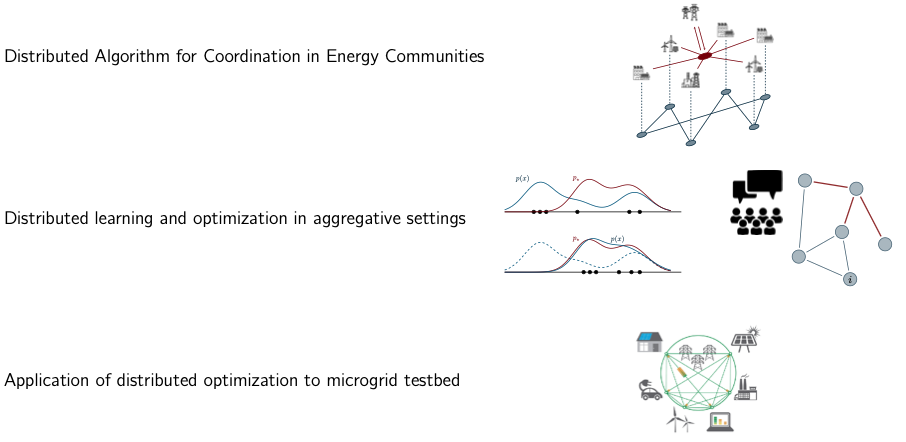
Key contributions include:
-
Development of ADMM-based distributed algorithms with tracking mechanisms
-
Extension to asynchronous and unreliable communication networks
-
Integration of learning components, including deep learning and derivative-free optimisation methods
-
Design of frameworks for data-driven optimisation, where cost functions are partially unknown
A novel direction involved the development of macroscopic models, enabling optimisation at an aggregate level through distributed learning mechanisms.
From a practical perspective, UNIBO developed software toolboxes for:
-
Energy trading
-
Distributed optimisation in ECs
-
Simulation of collective decision-making processes
In collaboration with UNIGE, UNIBO contributed to a realistic distributed optimisation framework implemented on a microgrid simulator, enabling the computation of optimal daily schedules for interconnected energy systems.
2. Potential Deviations and Impact
The project implementation remained fully aligned with the original proposal, with no substantial deviations in objectives or methodology.
However, the research led to important conceptual and methodological advances, including:
-
Development of aggregative optimisation frameworks
-
Integration of learning-based methods with distributed optimisation
-
Introduction of multi-resolution approaches, combining microscopic and macroscopic perspectives
These advances significantly enhance the modelling and optimisation of ECs as complex distributed systems.
3. Challenges and Lessons Learned
Several challenges were encountered:
-
Regulatory complexity: Interpreting evolving REC regulations and translating them into mathematical models
-
Data limitations: Scarcity of structured datasets for real-world ECs
-
External operations modelling: Limited availability of data for interactions with markets and other ECs
-
System abstraction: Identifying key features for distributed optimisation models
Close collaboration among partners was essential in addressing these challenges, enabling consistent modelling assumptions and methodological alignment.
4. Future Directions
Future research will extend the project results toward:
-
Stochastic and predictive modelling frameworks
-
Multi-energy systems, integrating electrical, thermal, and other energy carriers
-
Cross-country regulatory analysis, assessing transferability of methods
-
Data-driven approaches, supported by improved data collection
Additional research is needed to better understand participant behaviour, particularly decision-making dynamics related to joining, leaving, and re-joining ECs.
The project also provides a strong basis for real-world deployment, supporting the development of new ECs in collaboration with public authorities and industry.
5. Conclusion
The ECODREAM project has delivered significant contributions to both the theoretical and applied domains of Renewable Energy Communities and sustainable energy systems.
The developed methodologies:
-
Advance the state of the art in distributed optimisation and control
-
Enable practical tools for energy management and planning
-
Support technology transfer and industrial uptake
The results provide a solid foundation for future research and innovation, with strong potential for scaling to broader applications, including cross-border European contexts.
See also:
ECODREAM Project Results/Final Plenary Workshop Presentations
ECODREAM Project – Scientific Publications